
Purchasing6 min read
One Part, Many Vendors: Keeping a Vendor Price List per Item
Managing component costs across multiple suppliers is a major challenge for Indian SMEs. Learn how to maintain a reliable vendor price list per item.
17 November 2026
Purchasing and vendor pricing
Most small factories buy the same part from two or three vendors at different prices. Velom keeps every price each vendor quoted or charged, applies your price policy, and turns shortages into draft purchase orders.
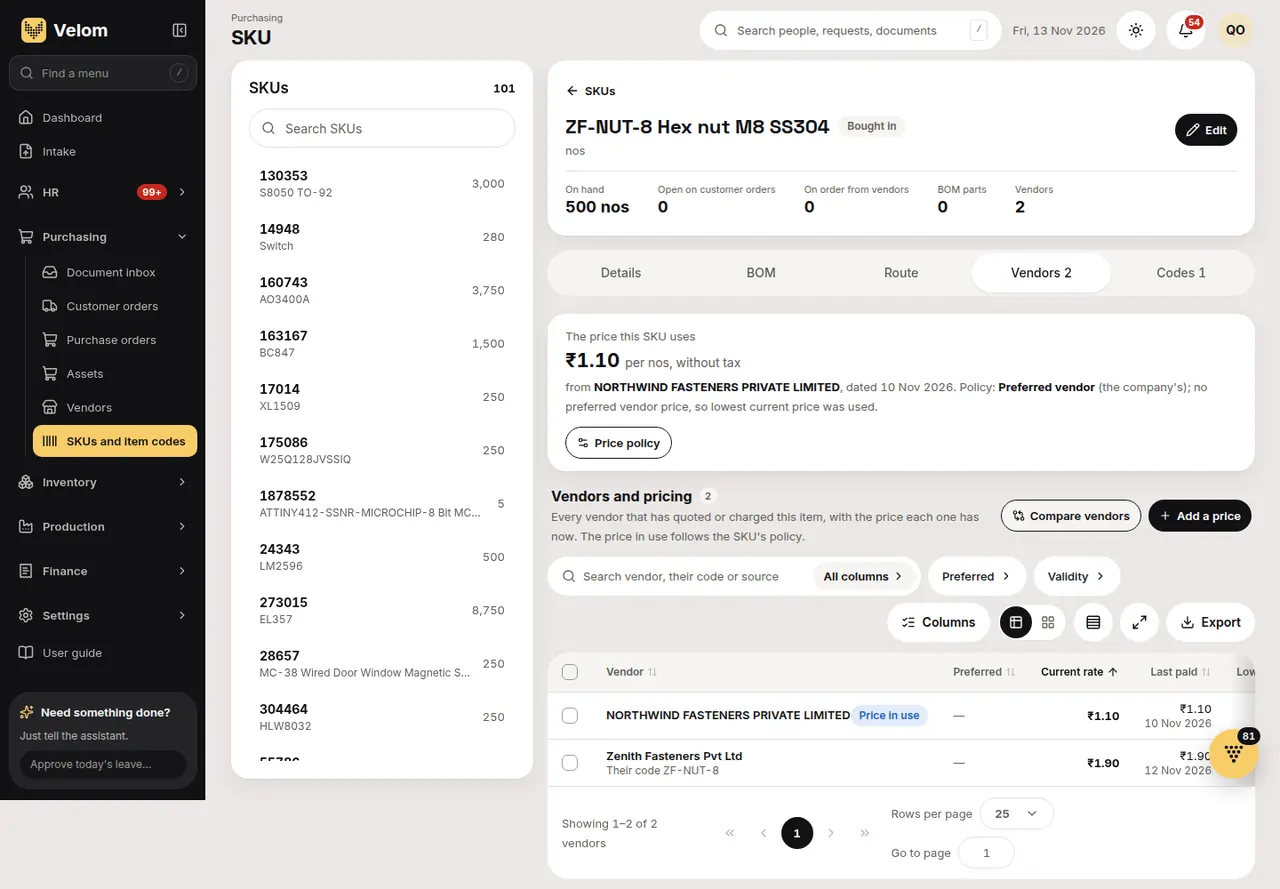
Velom keeps every vendor's price for each item with its history, so a purchase order starts from the right rate. Purchase orders, receipts and vendor bills stay linked, and rates from approved invoices update the price list. You can compare vendors per item and see what you really paid.
Velom app by Appikorn · Updated
Add SKUs and vendors, or let Intake create them from invoices you already have.
Quotations, POs and invoices add dated prices to each SKU's vendor list.
Raise POs by hand or generate drafts from shortages, then send the PDF.
Record goods received and match the vendor bill before payment.
Each SKU has a Vendors tab with every price a vendor quoted or charged, with the date and where it came from: a quotation, a purchase order or an invoice read in Intake. A price policy decides which price the item uses: the preferred vendor, the lowest current price, the latest price paid, or an average.
Vendor comparison puts the vendors for one part side by side: price at your quantity, lead time, minimum order, last price paid and a score.
Purchase orders work like customer orders. When an order changes, Velom keeps the old version and makes a new revision, so you can see exactly what changed. A change one side asks for is recorded with the evidence and takes effect only when both sides approve.
Start from what is short for planned production. Velom proposes draft purchase orders, one per vendor, with quantities rounded up to each vendor's pack and minimum order. You check and send them.
A vendor bill is checked line by line before approval. With a purchase order the match is three-way: the PO, the goods received and the bill. Without one it is two-way. Differences in rate or quantity above your tolerance are shown, not hidden.
Each vendor record keeps contacts, the items they supply and at what price, their documents and a scorecard of how they perform. A vendor that also does job work for you is the same record with a job work role, so pricing and custody stay together.
Most of the buying work in a small factory is repetitive, and Velom is arranged around that routine. Start the week from the shortage list for planned production rather than from memory. Check the price in use for each item against the latest quotation, and change the preferred vendor only with a reason you can read back later.
Follow open purchase orders by their due dates, and short-close what will not come so the planner stops counting it. When the goods arrive, the store records the receipt and any rejection, and the bill is matched before it reaches accounts.
Yes. Each SKU keeps every vendor's price with its date and source, and a price policy decides which one is used.
Yes. When a vendor invoice is approved in Intake, its line rates are added to the vendor prices of the matching SKUs.
Yes. The Owner designs a document template once: company block, numbering, columns, tax display, terms and signature.
You download or print the PDF and send it yourself. Mail text is given to copy.
Purchasing6 min read
Managing component costs across multiple suppliers is a major challenge for Indian SMEs. Learn how to maintain a reliable vendor price list per item.
17 November 2026
Purchasing6 min read
Simplify your procurement by splitting vendor invoice lines across multiple internal SKUs and maintaining accurate price history for every component.
15 November 2026
Get the Android app on Google Play, or sign in on the web if your company already uses Velom.