Inventory6 min read
Batch and Lot Tracking: Managing Inventory Quality in Indian Factories
Effective batch and lot tracking allows factory owners to trace parts back to their source, ensuring quality control and accurate inventory records.
By Appikorn team ·
In this article
Short answer
How does batch and lot tracking help in a factory?
Batch and lot tracking allows you to link every unit of raw material to a specific vendor, invoice, and purchase date. This visibility helps you identify the origin of defective parts, perform targeted quality checks, and maintain accurate inventory records, which prevents costly rework and production delays.
The problem: a realistic day in an Indian SME factory
In a typical Indian manufacturing unit, the store keeper starts the day by checking the physical stock against a printed ledger. The production manager arrives early, demanding raw materials for an urgent order. However, the store keeper finds that the specific grade of steel required is missing, even though the records show a surplus. When they finally locate the material in a corner, they realize it came from two different vendors. One batch is high quality, while the other has caused welding defects in previous runs. Because there is no way to distinguish between these batches, the entire stock is now suspect.
This scenario happens daily. Without clear visibility into which vendor provided which specific batch, the factory is flying blind. When a customer reports a defect after shipment, the team cannot trace it back to a particular invoice or delivery date. They are left guessing whether the issue was poor raw material, a machine setting, or a process error. This uncertainty forces the production team to either scrap perfectly good parts or risk shipping faulty ones, both of which hurt the bottom line and customer trust.
What it costs: time, rework, money and risk
The cost of poor inventory visibility extends far beyond the price of the materials. When a defective batch is used in production, the wasted labour hours and machine time are often more expensive than the material itself. If a defect is only discovered at the final assembly stage, the cost of dismantling the product to replace a single part can be immense. This rework disrupts the entire production schedule, pushing back delivery dates for other customers and creating a cascade of delays throughout the factory floor.
Furthermore, the risk of reputational damage is significant. If a faulty product reaches a customer, the trust built over years can vanish in a single shipment. In industries where safety or precision is critical, such as automotive components or electrical enclosures, a single bad batch can lead to massive returns and potential legal liabilities. The time spent by the purchase manager in disputes with vendors over material quality is also a hidden cost, as they struggle to prove which specific delivery caused the issue without clear documentation.
How the team did it before: paper, spreadsheets, WhatsApp
Most small factories rely on a combination of physical registers, Excel sheets, and informal communication to track stock. The store keeper notes down incoming goods in a hardbound book, often missing details like the batch number or the manufacturer's serial code. Later, this is manually typed into a spreadsheet that quickly becomes outdated as items move in and out of the store. If the store keeper is absent, the system often breaks down entirely, leading to errors in data entry that are never corrected.
When a quality issue arises, the team resorts to WhatsApp messages, searching through chat histories to find who sent what and when. This is an unreliable way to manage supply chain data. Attachments like delivery challans get buried in phone storage, and critical information about the vendor or invoice rate is lost. Without a centralized, immutable ledger, the team is forced to rely on memory. This informal approach makes it impossible to perform a root cause analysis, as there is no reliable record linking a finished product to the specific lots of raw materials used to create it.
How Velom solves it, step by step
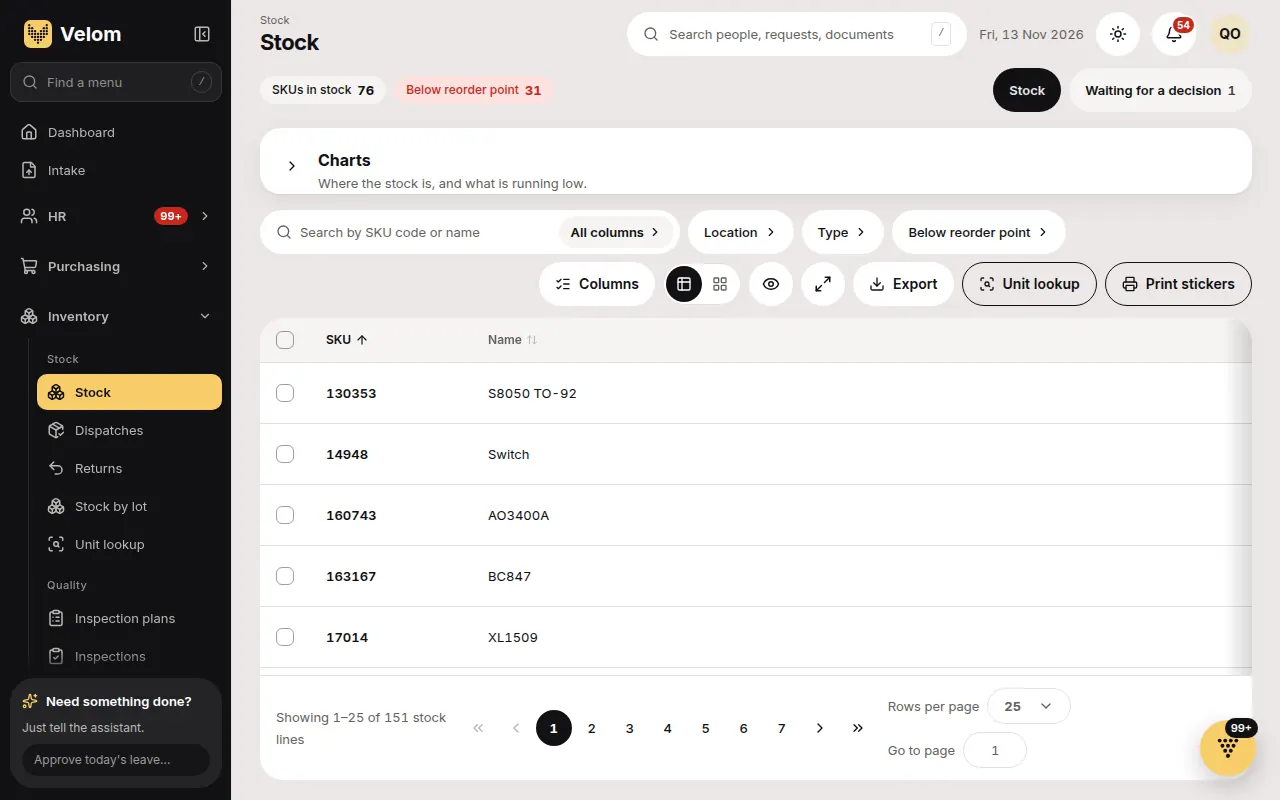
Velom brings structure to the chaos by ensuring that every movement of stock is recorded with its origin. By using inventory management features, you can maintain a ledger where every item is tracked by batch, knowing exactly which vendor, invoice, and rate are associated with every unit on your floor.
- Record Receipts: When goods arrive, record them directly in the app. You can add them from a vendor invoice using the document intelligence feature, which automatically captures the vendor and invoice details.
- Assign Lot Details: Each receipt is assigned a specific lot. This links the quantity to the source, ensuring you always know which vendor provided the parts.
- Track Movements: Every time a part is moved to the production floor, the system deducts it from that specific lot. The ledger records every movement, ensuring the balance always matches the sum of transactions.
- Use QR Stickers: For critical parts, print a 10-character ID as a QR sticker. Scanning this sticker allows you to see the entire history of that unit, including where it has been and which batch it belongs to.
- Review Variances: If a batch is found to be defective, you can immediately identify which production orders used materials from that specific lot, allowing for targeted recalls rather than stopping all production.
Example scenario
This is an illustrative example, not a real customer. On Monday morning, a factory receives 500 units of a critical component from Vendor A and 500 from Vendor B. The store keeper enters both batches into Velom, capturing the invoice numbers and rates for each. By Tuesday, the production team starts an order for 200 units. The store keeper issues 200 units from the Vendor A batch, which the system records as a movement linked specifically to that lot.
On Thursday, a quality inspector finds a defect in one of the finished items. Because the system tracks the lot, the manager looks up the production order and sees exactly which batch was used. They realize the defect originated from the Vendor A lot. By Friday, the team inspects the remaining 300 units from Vendor A and finds a hidden flaw, while the 500 units from Vendor B remain untouched and safe to use. The factory avoids a total production shutdown and simply contacts Vendor A to resolve the issue with the specific invoice, saving hundreds of hours of wasted work.
What to check before you start
Before implementing a new tracking system, ensure your internal processes support the data you need to capture. Check that your store team understands the importance of recording the correct batch numbers at the point of entry. It is also helpful to review your existing purchasing documents to ensure they contain all necessary details like HSN codes and supplier references. For specific guidance on regulatory requirements, you can check the latest notification on the official GST portal regarding input tax credit and documentation. Finally, ensure that your team has clear roles and permissions in the app so that only authorized staff can approve stock movements or adjust records.
Start by organizing your physical store space to align with your digital records. Label your shelves and bins clearly so that the physical location matches the location recorded in the app. Regular cycle counts are essential to keep the digital ledger accurate. By maintaining a disciplined approach to data entry, you ensure that your inventory system remains a reliable source of truth, helping you avoid costly mistakes and improve the overall efficiency of your manufacturing operations.
Frequently asked questions
How does batch and lot tracking help in a factory?
Batch and lot tracking allows you to link every unit of raw material to a specific vendor, invoice, and purchase date. This visibility helps you identify the origin of defective parts, perform targeted quality checks, and maintain accurate inventory records, which prevents costly rework and production delays.
Can Velom track stock by location?
Yes, Velom tracks stock by SKU and location. Every movement is recorded in a ledger, ensuring the stock balance always reflects the sum of all movements, including receipts, production issues, and returns.
Does Velom automatically generate e-way bills for stock transfers?
No, Velom does not generate e-way bills or interact with government portals. You must generate and manage your e-way bills on the official GST portal as required by law for the movement of goods.
How do I handle defective batches?
When you identify a defective batch, you can use the system to trace which production orders used those specific items. This allows you to isolate the affected products and verify the quality of remaining stock from that same vendor lot.