Production5 min read
Production planning and control for a small factory, in plain terms
Effective production planning and control prevents material shortages and keeps your factory floor running without constant firefighting.
By Appikorn team ·
In this article
Short answer
How does Velom help with production planning and control?
Velom helps by digitizing your bill of materials and production orders. It automatically calculates shortages based on your current stock and open orders, manages kits for each run, and tracks part usage and returns. This prevents idle time, reduces material wastage, and ensures your production floor always has the necessary components.
The problem: a realistic day in an Indian SME factory
Imagine the production floor of a typical electronics assembly unit. The morning shift begins, and the assembly team is ready to start a batch of 100 control boards. The production manager arrives, only to find that the store keeper is struggling to locate a specific capacitor required for the build. A quick search reveals that the stock is lower than expected. The team discovers that some components were used for a previous repair job without being recorded, and others have simply gone missing from the open bins.
This situation is common in factories where the gap between the paper records and the physical stock on the floor is wide. The production manager cannot start the run because the kit is incomplete. The workers stand idle, waiting for the store keeper to scramble through shelves or check if a new order can be placed. This creates a ripple effect, delaying the delivery date promised to the customer and causing frustration across the entire team.
What it costs: time, rework, money and risk
The cost of poor planning goes far beyond the immediate delay of a single batch. When production stops, the overhead costs of the factory—electricity, machine maintenance, and labor—continue to pile up. Idle time is a direct drain on your profit margins, and the pressure to catch up often leads to rushed work, which increases the likelihood of soldering errors or faulty components making it into the final product.
Beyond the floor, there is the hidden cost of inventory mismanagement. When parts vanish or are used without documentation, you end up overstocking items you don't need while facing sudden shortages of critical components. This ties up your working capital in excess stock and creates a constant cycle of emergency purchasing. In the long run, this lack of visibility makes it impossible to accurately cost your products or forecast your material needs for future growth.
How the team did it before: paper, spreadsheets, WhatsApp
Most small factories rely on a combination of manual methods to keep track of their production. The process often starts with a printed bill of materials (BOM) that is manually checked against physical stock. If a part is missing, a message is sent via WhatsApp to the purchase manager, who then checks a spreadsheet to see if a supplier has been contacted. This fragmented approach relies heavily on the memory of individual employees.
Spreadsheets are frequently updated after the fact, meaning the data is almost always behind the reality of the floor. Paper challans get lost, and verbal instructions given on the shop floor are never recorded. When a discrepancy arises, there is no single source of truth to check. The team spends more time verifying what should be in stock than actually assembling the product, turning production management into a daily exercise of damage control.
How Velom solves it, step by step
Velom brings structure to the factory floor by digitizing the entire production cycle, ensuring that every part is accounted for from the moment it enters the store to the final assembly. By using the production features, you can manage your kits with precision.
- Create a structured bill of materials (BOM) in Velom that lists every part required for one unit of your product.
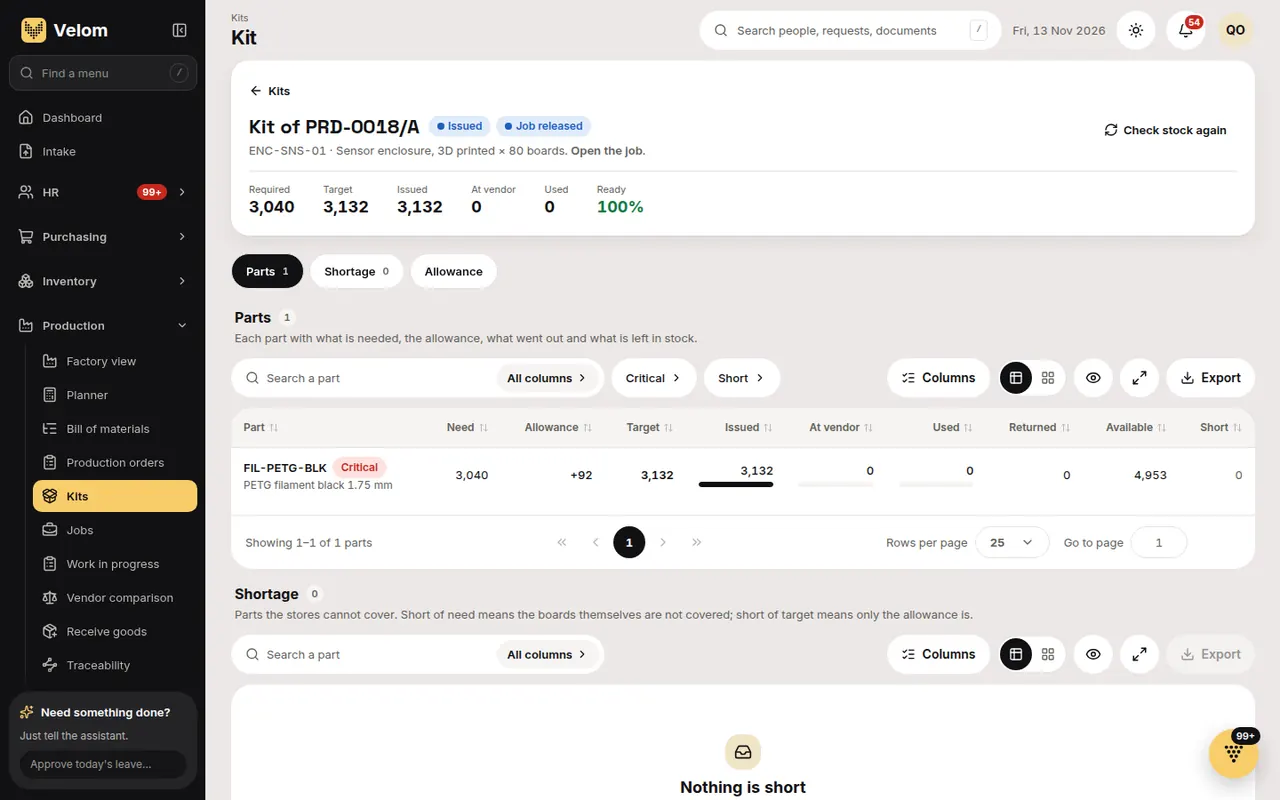
- Use the planner to multiply your BOM for the total quantity of your order, automatically subtracting current stock and open orders to show exactly what is short.
- Generate a production order for the batch, which triggers the creation of a kit specifically for that run.
- Assign an allowance per part to account for natural attrition or minor wastage during assembly.
- Issue the kit to the production floor, recording the exact quantity given to the team.
- Track the usage and any returns of leftover parts, ensuring the ledger always matches the physical balance.
- Review the readiness of the order on the floor, which clearly displays what the team is waiting for before work can begin.
Example scenario
This is an illustrative example, not a real customer. On Monday, the production manager creates an order for 100 units. The system calculates the total parts needed, including a small allowance for potential loss. On Tuesday, the planner shows that 500 resistors are short. The store keeper checks the inventory and realizes the stock was not updated from a previous delivery, so they correct the records. On Wednesday, the purchase order for the resistors is approved, and the parts arrive. By Thursday, the kit is complete, and the production order status changes to ready. The assembly team starts the work on Friday morning. Because every part was kitted and tracked, the team finishes the batch by Saturday afternoon with no idle time and a clear record of parts used versus parts returned. The manager sees the exact cost of the run in real-time, allowing for better planning for the next batch.
What to check before you start
- Ensure your bill of materials is current and reflects the actual parts used in your assembly process.
- Verify that your stock levels are accurate by performing a physical count before moving to a digital system.
- Define your allowance levels based on historical data rather than guesswork to avoid over-issuing parts.
- Set up your purchasing lead times so the planner can accurately forecast when new stock will arrive.
- Check the latest notification regarding GST and job work regulations if you send parts to external vendors for processing.
- Confirm that your team understands the importance of recording every movement, including returns of unused components.
By shifting from manual tracking to a system that records every movement of goods, you gain the visibility needed to scale your operations. Start by digitizing your BOMs and ensuring your stock ledger is reliable. This foundation will allow you to plan your production cycles with confidence, reduce waste, and ensure that your assembly team always has exactly what they need to succeed.
Frequently asked questions
How does Velom help with production planning and control?
Velom helps by digitizing your bill of materials and production orders. It automatically calculates shortages based on your current stock and open orders, manages kits for each run, and tracks part usage and returns. This prevents idle time, reduces material wastage, and ensures your production floor always has the necessary components.
Can I track parts if I send them to a job worker?
Yes, you can record parts sent to job work vendors using job work challans. Velom tracks these as stock held at the vendor, allowing you to monitor what is sent and what is returned, ensuring your inventory remains accurate and you are prepared for GST compliance.
Does the system automatically order parts when they are short?
No, Velom does not place orders on vendor websites. It identifies the shortage and helps you generate a draft purchase order based on your preferred vendor and pricing, which you then review and approve before sending it to the supplier.
How do I handle parts that are lost during assembly?
You can define an allowance per part within the production order. This accounts for expected attrition during the assembly process. Any usage beyond this allowance is recorded, allowing you to monitor and address issues on the floor.