Quality5 min read
Improving AQL Sampling and Returns: A Practical Quality Guide
Customer returns often become a hidden cost in small factories. This guide explains how to track product faults and decisions to improve quality control.
By Appikorn team ·

In this article
Short answer
How can I stop customer returns from piling up in my factory?
To stop returns from piling up, you must implement a formal, digital tracking process. Use a system to record the receipt, document the specific fault using a checklist, and assign a clear decision like repair or scrap. This ensures every unit has a recorded history and prevents items from being forgotten.
The problem: a realistic day in an Indian SME factory
In a typical electronics assembly unit, the day starts with the store keeper receiving a box from a courier. It is a return from a customer. The box is placed in a corner, often labeled simply as "Return." The technician is busy with a new production run, and the purchase manager is dealing with vendor shortages. By the end of the day, that box is buried under new stock. No one has checked why the unit failed, whether it was a manufacturing defect or a shipping issue, or if it can be repaired at all.
This cycle repeats daily. Returns pile up on the shop floor, creating clutter and confusion. The production team loses track of which batches had issues, and the sales team cannot answer the customer because they do not know if the unit is being repaired, replaced, or scrapped. Without a formal process, the factory operates in the dark, repeating the same production errors because the feedback loop from the customer is broken.
What it costs: time, rework, money and risk
The cost of unmanaged returns goes far beyond the price of the product itself. When a faulty unit sits in a corner, it consumes valuable floor space. More importantly, it represents a missed opportunity for learning. If a specific component is failing in the field, the factory will continue to use that same faulty part in new production runs, leading to more returns and damaged reputation.
There is also the hidden cost of labor. Technicians often spend hours "guessing" what is wrong with a returned item because there is no record of the original assembly data. If the return was due to a simple assembly error, it could have been fixed quickly. Instead, it becomes a long, drawn-out investigation. Eventually, the lack of a clear policy on returns leads to customer frustration, potential loss of future orders, and internal friction between the quality, production, and sales teams. Managing these items effectively is essential for any electronics assembly unit aiming to scale.
How the team did it before
Before moving to digital systems, most factories rely on a combination of paper notebooks, loose sticky notes, and WhatsApp messages. The process usually begins with a phone call or a message from the customer. The store keeper scribbles the customer name and the product serial number on a scrap of paper and sticks it to the box. If the paper falls off, the unit becomes an "orphan" with no history.
Spreadsheets are then used to track these items, but they are rarely updated in real-time. A technician might perform an inspection and write the results in a personal diary, intending to update the spreadsheet later. That "later" never comes. WhatsApp groups become the main source of truth, with messages like "Did we fix the board for Client X?" buried under hundreds of other work updates. This manual approach is prone to human error, lost data, and a complete lack of accountability, making it impossible to perform reliable quality checks or trend analysis.
How Velom solves it, step by step
Velom provides a structured way to handle returns by linking every unit to its production history and allowing for formal inspection records. Instead of guessing, the team uses a systematic workflow to ensure every returned item is accounted for and processed correctly.
- The store keeper records the receipt of the returned unit, linking it to the original sale or customer record in the system.
- The quality team initiates an RMA (Return Merchandise Authorization) record, which captures the initial fault reported by the customer.
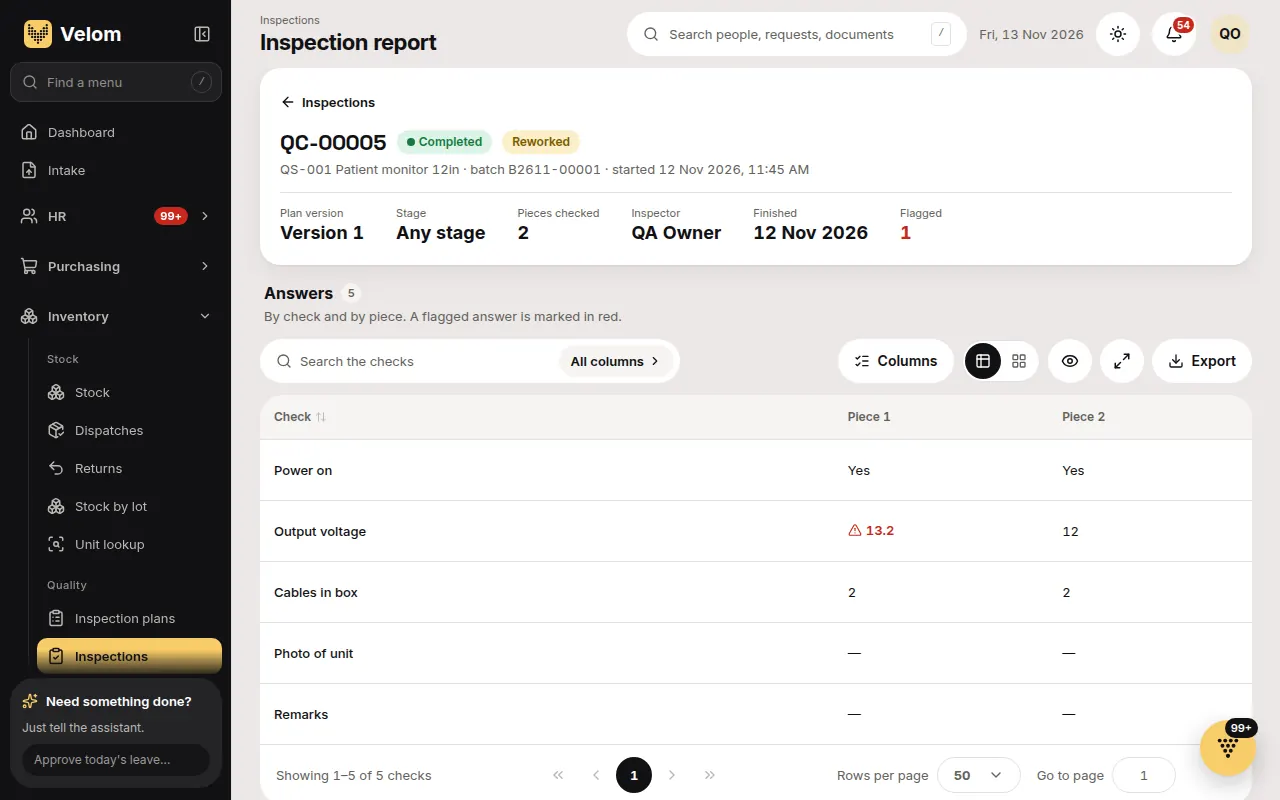
- A technician performs an inspection using a predefined checklist in the system, ensuring that every critical point is verified against the original assembly standards.
- The system flags any out-of-limit answers, forcing the technician to document the specific fault and the likely cause.
- The manager reviews the inspection data and makes a final decision: repair, replace, or scrap.
- The system updates the stock ledger automatically, ensuring that the inventory reflects the movement of the unit, whether it is back in stock after repair or removed as scrap.
- The entire history of the unit, from original assembly to the final return decision, remains linked, providing clear traceability.
Example scenario
This is an illustrative example, not a real customer. On Monday morning, a technician receives a returned circuit board. The store keeper enters the unit ID into Velom. By Tuesday, the technician uses the quality inspection plan to test the board. They find a cold solder joint, which is identified as an assembly error. The technician logs the fault, and the system automatically links it to the original production batch. On Wednesday, the production manager reviews the entry, confirms the root cause, and approves a rework order. By Friday, the board is repaired, re-tested against the same inspection plan, and marked as ready for dispatch. The entire process is documented, and the factory now has a record that prevents this specific assembly error in future batches.
What to check before you start
Before implementing a new quality workflow, ensure your team is aligned on these basics:
- Define your inspection checklists clearly for every product version.
- Ensure every unit has a unique identifier, such as a serial number or QR code.
- Establish a clear policy on how long you keep records of returns for GST and internal audit purposes.
- Train staff on the importance of entering data immediately rather than waiting until the end of the week.
- Regularly review the "Needs review" items in your system to prevent bottlenecks.
By digitizing your quality process, you move away from reactive firefighting and toward a proactive system that values data and consistency.
Frequently asked questions
How can I stop customer returns from piling up in my factory?
To stop returns from piling up, you must implement a formal, digital tracking process. Use a system to record the receipt, document the specific fault using a checklist, and assign a clear decision like repair or scrap. This ensures every unit has a recorded history and prevents items from being forgotten.
What is the benefit of linking inspection results to production batches?
Linking inspection results to production batches allows you to identify recurring defects. If multiple returns share the same fault from the same batch, you can quickly trace the root cause, such as a faulty component or a specific operator error, and fix the issue before it affects more units.
Should I use AQL sampling for customer returns?
AQL sampling is typically used for incoming goods or large batches. For individual customer returns, it is better to perform a 100% inspection on each unit to understand the specific failure, as each return is a unique case that requires a specific resolution.
How does digitizing quality records help with GST compliance?
Digitizing records provides an accurate audit trail of goods entering and leaving your factory. When you record returns and replacements, you have the necessary documentation to justify adjustments in your stock and tax records, which is crucial for maintaining transparency during a GST audit.