Quality5 min read
Incoming Quality Inspection Procedure: A Practical Guide for Factories
A formal incoming quality inspection procedure helps Indian manufacturers catch defects early, preventing faulty materials from disrupting production lines.
By Appikorn team ·

In this article
Short answer
What should be done if a vendor sends goods without a proper invoice or challan?
You should quarantine the goods immediately and notify your purchase department. Do not accept the items into your inventory until the correct documentation is provided, as this creates issues for your GST records and inventory accuracy.
Establishing a Standard for Material Receipt
An effective incoming quality inspection procedure is the first line of defense against production delays and poor product quality. When raw materials or components arrive at your factory gate, the immediate goal is to verify that the items match what was ordered and meet your internal quality standards. Without a structured process, defective parts often enter the store, only to be discovered during assembly or, worse, after the final product reaches the customer. This leads to costly rework, wasted labor, and damaged supplier relationships.
The process begins the moment the delivery vehicle enters the premises. Storekeepers and quality inspectors must work in tandem to ensure that every shipment is accounted for against a valid purchase order. By standardizing how materials are received, logged, and inspected, you create a trail of accountability that simplifies inventory management and provides clear data on which vendors consistently deliver quality goods versus those that require corrective action.
The Preliminary Gate Check
Before any item enters your storage area, perform a physical verification of the shipment. This involves checking the delivery challan against your purchase order to confirm quantities, item descriptions, and part numbers. During this stage, inspect the packaging for signs of damage or tampering. If a container arrives crushed or wet, the contents are likely compromised, and you should document this immediately before proceeding with the formal inspection.
It is also essential to verify that the documentation provided by the vendor is complete. For engineering workshops or manufacturers dealing with critical components, ensure that test certificates or certificates of analysis (COA) are included if the purchase order mandates them. If the paperwork is missing or the quantity does not match the invoice, do not accept the goods into your main inventory stock until the discrepancy is resolved. Marking these items as 'pending inspection' keeps your live stock counts accurate.
Designing Your Inspection Checklist
Every product requires a specific inspection plan, as the criteria for a steel sheet differ significantly from those for an electronic sensor. Create a simple checklist for each category of material. This list should include visual checks, dimensional measurements, and functional tests where applicable. For example, if you are receiving fasteners, your checklist might include checking for rust, verifying thread pitch, and ensuring the quantity matches the pack label.
Keep these checklists accessible to the team on the shop floor. By defining clear pass-fail criteria, you remove subjectivity from the process. When an inspector knows exactly what to look for, the inspection becomes faster and more reliable. If a part fails a specific check, record the exact reason for rejection. This data is invaluable when you conduct your periodic vendor performance reviews, as it provides objective evidence of the quality issues you have encountered over time.
Handling Rejections and Returns
When goods fail to meet your standards, your incoming quality inspection procedure must dictate how to handle the rejected material. Segregate rejected items immediately to prevent them from being mixed with accepted stock. Use a clearly marked 'rejection area' or quarantine zone in your warehouse. Failing to isolate these items is a common cause of production errors where faulty parts are accidentally issued to the shop floor.
Once items are quarantined, notify the purchase department to initiate the return process or request a replacement. Ensure that you have a formal record of the rejection reason, the quantity returned, and the date of the transaction. This documentation is critical for accounting purposes, especially when you need to adjust your accounts payable or process a credit note from the vendor. Maintaining a clean ledger of these movements ensures that your GST-related records and financial statements remain accurate.
Integrating Quality with Production
The link between inspection and production is vital for efficiency. When parts are cleared, they should be moved to their designated storage locations or directly to the production line. If you are running a job work unit, ensure that the materials sent to you by the principal manufacturer undergo the same level of scrutiny. Since you are responsible for the quality of the final assembly, you must ensure that the inputs you receive are fit for purpose.
Use your inspection data to identify trends. If a particular vendor consistently delivers batches with high rejection rates, it may be time to revisit your procurement strategy. Perhaps the vendor needs clearer specifications, or maybe it is time to source from a more reliable supplier. By feeding this information back into your purchasing process, you turn quality control into a strategic tool that improves your entire manufacturing output rather than just being a gatekeeping task.
How Velom Helps
Velom provides tools that support your incoming quality inspection procedure by digitizing the flow of information. You can use the document intelligence feature to quickly process vendor invoices and match them against purchase orders, ensuring that the quantities and rates you are inspecting align with your records. When you record incoming goods, Velom helps you track these movements in your inventory ledger, ensuring that your stock balances are always updated based on actual receipts.
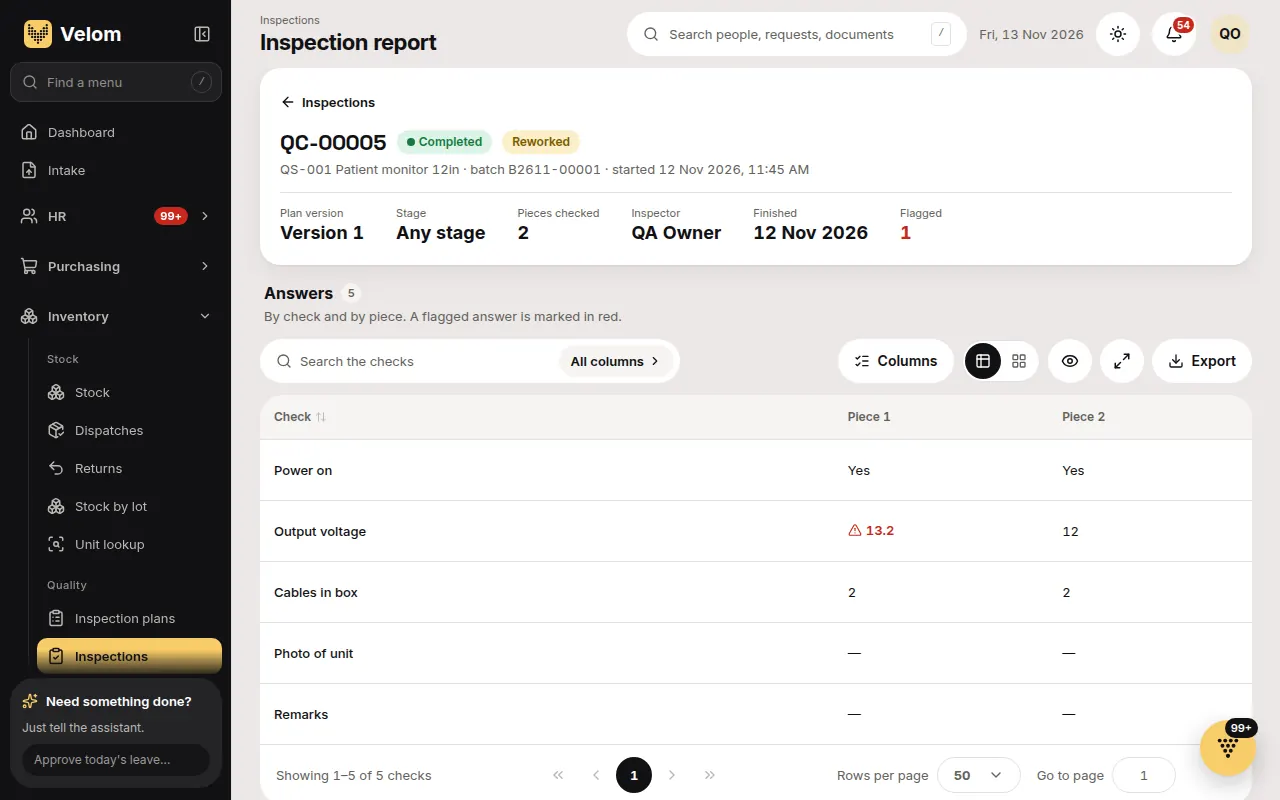
Furthermore, Velom allows you to record inspection results directly, flagging out-of-limit answers so that management is aware of quality trends. By maintaining a clear audit trail of every receipt, rejection, and movement, the system helps you keep your factory floor organized. Whether you are managing electronics assembly or general manufacturing, having reliable data at your fingertips makes it easier to resolve discrepancies with vendors and maintain a smooth production schedule.
Maintaining Long-Term Reliability
Consistency is the hallmark of a successful manufacturing unit. Over time, your incoming quality inspection procedure should evolve based on the data you collect. If you find that a specific supplier has improved their quality, you might reduce the frequency of full inspections for their shipments, opting instead for spot checks to save time. Conversely, if quality dips, increase the stringency of your checks immediately.
Remember that quality is a shared responsibility. While the inspection team is the final gatekeeper, the purchasing team should communicate your quality expectations to vendors clearly during the ordering phase. By fostering a culture where every team member understands the impact of poor-quality materials on the final product, you reduce waste and improve your operational efficiency. Regularly review your processes, update your checklists as product designs change, and ensure that your team has the right tools to document every step of the journey from the factory gate to the final dispatch.
Frequently asked questions
What should be done if a vendor sends goods without a proper invoice or challan?
You should quarantine the goods immediately and notify your purchase department. Do not accept the items into your inventory until the correct documentation is provided, as this creates issues for your GST records and inventory accuracy.
How often should I update my quality inspection checklists?
Review your checklists whenever you introduce a new product, change a raw material specification, or notice recurring quality issues. Keeping them updated ensures that your inspectors are checking for the most relevant defects.
Is it necessary to inspect every single item in a shipment?
For critical components, 100% inspection is often recommended. For standard items, you can use statistically significant sampling plans, provided your historical data shows that the vendor consistently meets your quality standards.
How do I handle rejected items in my inventory records?
Rejected items should be recorded as a movement out of 'good' stock and into a 'quarantine' or 'rejected' status. This keeps your available stock count accurate and ensures that the items are not accidentally issued to production.