Quality6 min read
Incoming Quality Inspection: Managing Factory Standards Effectively
A robust incoming quality inspection process prevents defective parts from reaching your production line, saving time and reducing costly rework.
By Appikorn team ·
In this article
Short answer
Why is incoming quality inspection critical for small factories?
Incoming quality inspection is essential because it identifies defective parts before they enter the production line. This prevents wasted labor, avoids assembly delays, and ensures that the final product meets customer standards, ultimately saving the factory from the high costs of rework and damaged relationships with clients.
The problem: a realistic day in an Indian SME factory
In a typical SME factory, the morning starts with a truck unloading materials at the store. The store keeper, often overwhelmed by multiple tasks, receives the delivery challan, verifies the physical count against the document, and signs off. He assumes the parts are correct because they look fine at a glance. He places the items into the bin, and the production team pulls them for assembly shortly after. By the afternoon, the assembly line stops. The technicians find that the capacitors are the wrong voltage or the metal brackets have burrs that prevent proper fitting. The production manager rushes to the store, only to find that the entire batch of raw material is faulty. The store keeper has no record of having checked these specific technical parameters, as he only confirmed the quantity received.
This scenario is common in workshops across India. Without a formal procedure, quality becomes an afterthought. The store keeper focuses on the inventory counts, while the production team focuses on volume. Because there is no structured inspection, the factory operates on trust rather than verification. When a defect is discovered, it is often too late, causing a cascade of delays that affect delivery timelines for the final customer.
What it costs: time, rework, money and risk
The cost of skipping a proper inspection goes far beyond the price of the defective part. When a faulty component is installed in a product, the labour invested in the assembly process is wasted. If the defect is caught during final testing, the product must be disassembled, repaired, and re-tested, which consumes double the time of the initial build. In some cases, the entire unit must be scrapped if the defect is permanent or if the repair compromises structural integrity.
Beyond internal costs, there is the risk to the company reputation. If a defective product reaches the customer, it leads to returns, negative feedback, and potentially lost future orders. Furthermore, constant rework creates a culture of firefighting. The production team becomes demotivated because they are constantly fixing errors instead of creating value. The financial impact is felt in the purchasing department, which must handle vendor returns, negotiate replacements, and manage the administrative burden of credit notes and re-procurement, all while the factory floor waits for replacement parts to arrive.
How the team did it before: paper, spreadsheets, WhatsApp
Before adopting digital tools, most factories rely on a combination of paper registers, shared spreadsheets, and instant messaging apps. The store keeper might maintain a physical notebook where he notes down the date, vendor name, and quantity. If he notices something is wrong, he might take a photo of the defect and send it via WhatsApp to the purchase manager. The purchase manager then has to manually track the complaint, call the vendor, and hope the message doesn't get lost in a sea of other chats.
Spreadsheets are often used to track rejections, but they are rarely updated in real-time. By the time the data is entered, the parts might have already been moved or used. This creates a disconnect between what is in the system and what is actually on the floor. Furthermore, there is no history of recurring issues with specific vendors. If a part fails, it is treated as an isolated incident, and the same vendor continues to supply the same faulty parts, perpetuating a cycle of inefficiency that is difficult to break without a unified record.
How Velom solves it, step by step
Velom provides a structured approach to quality by integrating inspection checklists directly into the receiving workflow. Instead of a vague check, the team follows a defined process that ensures nothing is missed.
- The store keeper triggers the inspection process upon receiving goods, using the intake feature to link the vendor invoice to the incoming shipment.
- The system loads the pre-configured inspection plan for that specific SKU, which acts as a digital checklist of required parameters.
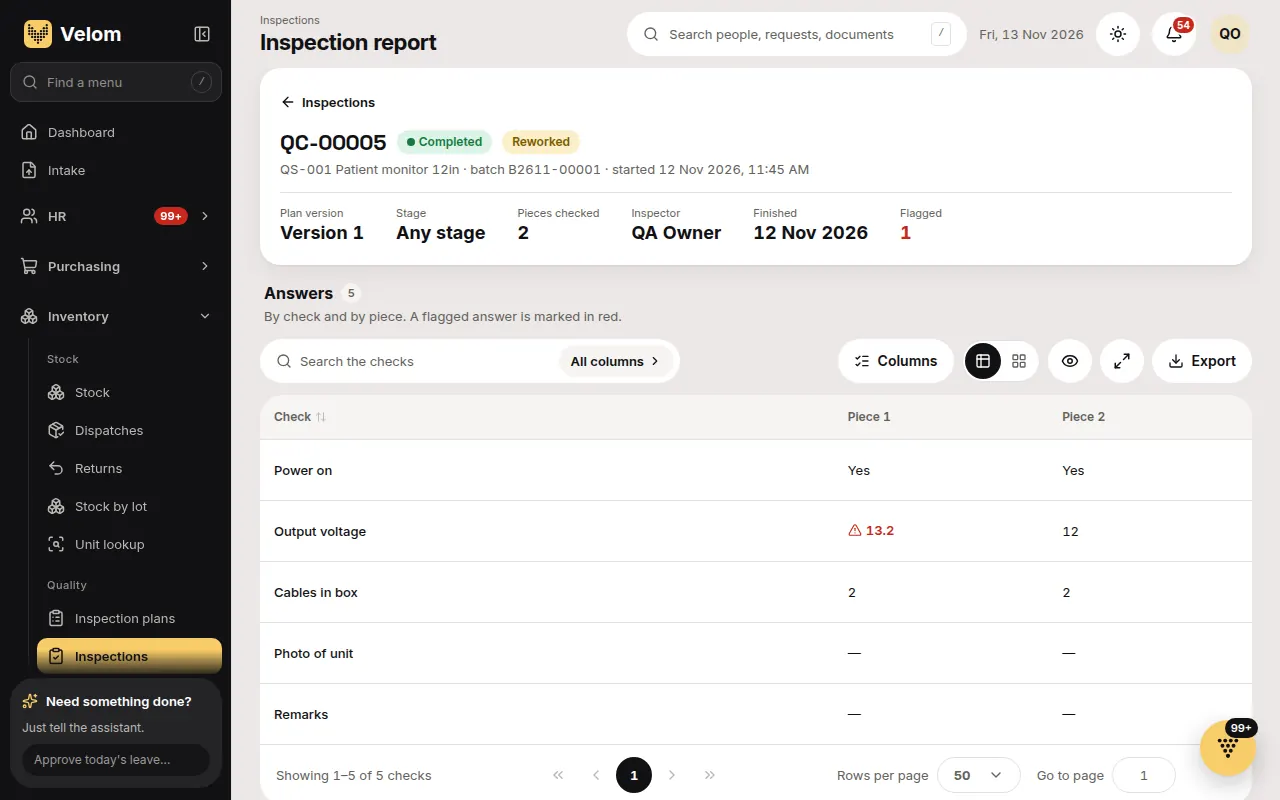
- The inspector checks each unit or sample against the checklist, entering values or selecting pass/fail status for each point.
- If a part fails any criteria, the inspector records the reason for rejection, which is immediately flagged in the system.
- The rejected quantity is automatically separated from the usable stock, preventing it from being issued to production.
- The system generates a report on the rejection, providing a clear trail that the purchase team can use to discuss quality issues with the vendor.
- The manager reviews the inspection results, ensuring that all findings are documented and that any necessary corrective actions are taken before the stock is moved.
Example scenario
This is an illustrative example, not a real customer. A factory receives a shipment of 500 aluminium housings. In the first week, without an inspection process, the store keeper accepts the shipment based on a count. The production team starts assembly on Monday. By Wednesday, they realize 50 housings have misaligned drill holes, causing 50 hours of wasted assembly time. The line is stalled for two days while waiting for replacement parts. The total cost includes the lost labour and the idle machine time.
After implementing Velom, the store keeper receives the same 500 housings. He opens the inspection checklist for that part. The checklist requires verifying the drill hole alignment against a sample. He finds the issue immediately. He marks 50 units as rejected in the app. The system flags this to the purchase manager, who contacts the vendor. The production team only uses the 450 good units, and they continue their work without interruption. The vendor replaces the 50 units within two days. The factory avoids the assembly waste entirely, and the production schedule remains on track.
What to check before you start
Before implementing a new inspection process, ensure your team is aligned on the technical requirements for each part. Start by categorizing your items based on criticality; high-value or high-precision parts should have more detailed checklists than standard consumables. Review your current production flow to identify where inspections are most needed—usually at the point of receipt and after critical assembly steps. Ensure that your staff understands that the goal of the inspection is to maintain standards, not to assign blame. Finally, verify that your vendor records are up to date, as this will make it easier to track which suppliers are consistently meeting your quality expectations and which ones need to be audited or replaced.
For statutory compliance regarding goods, always check the latest notification from the Central Board of Indirect Taxes and Customs regarding documentation requirements for inward supplies. Your inspection process should support your overall finance and inventory records to ensure that any rejected goods are properly accounted for in your ledger.
Consistent quality inspection is the foundation of a reliable supply chain. By moving away from informal checks and toward a digital, checklist-based system, you protect your production line from the high costs of rework and delay. Use the tools available to build a culture where quality is verified at every step, ensuring that only the best components enter your assembly process.
Frequently asked questions
Why is incoming quality inspection critical for small factories?
Incoming quality inspection is essential because it identifies defective parts before they enter the production line. This prevents wasted labor, avoids assembly delays, and ensures that the final product meets customer standards, ultimately saving the factory from the high costs of rework and damaged relationships with clients.
How does a digital checklist improve upon paper-based inspections?
Digital checklists ensure that every inspection follows the same standard procedure, reducing human error. They provide real-time data, create an audit trail for vendor performance, and prevent faulty parts from being accidentally mixed with usable inventory, which is nearly impossible to track reliably with paper.
What should be included in an incoming inspection checklist?
A checklist should include specific technical parameters relevant to the part, such as dimensions, material finish, voltage, or fitment. It should also include a clear pass/fail status for each point and a section for recording the reason for rejection to help in future vendor communication.
How do I handle rejected goods in my inventory system?
Rejected goods must be segregated from usable stock immediately. In a digital system, you should record the rejection against the specific vendor invoice, which updates your inventory balance to reflect only the good units, ensuring your production team never accidentally consumes faulty materials.