Leave6 min read
Leave approval workflow: fixing the gap between requests and payroll
Verbal leave approvals and WhatsApp messages often vanish before payday. A structured leave approval workflow ensures every day off is accounted for.
By Appikorn team ·
In this article
Short answer
How does a structured leave approval workflow prevent payroll errors?
A structured workflow ensures that all approved leaves are automatically logged in the attendance register. Because these records are directly linked to the payroll system, the HR team does not need to manually calculate deductions or reconcile informal requests, which eliminates the risk of human error and pay discrepancies.
The problem: a realistic day in an Indian SME factory
In a typical electronics assembly unit, the morning shift begins with a flurry of activity. The production manager walks the floor, checking if the PCB assembly lines are fully staffed. Suddenly, the supervisor reports that three operators are missing. A quick check of the WhatsApp group reveals messages sent late last night: one worker has a family emergency, another is unwell, and a third simply didn't show up. The manager, busy with a customer order, gives a quick thumbs-up emoji to the messages, assuming the information will somehow reach the HR office.
By the time the payroll cycle arrives at the end of the month, the HR person is buried in spreadsheets. They have a attendance log from the face attendance system, but it shows these workers as absent. The workers, however, claim they were granted leave. Because the approvals were scattered across informal chats, there is no central record. The HR person spends hours calling supervisors, digging through archived messages, and trying to reconstruct the reality of who was on sanctioned leave and who was just absent. This is a daily reality in many small factories where communication and record-keeping are disconnected.
What it costs: time, rework, money and risk
The cost of a broken leave process extends far beyond the time spent in meetings. When leave requests are not formally recorded, the factory suffers from a lack of visibility. Production planning becomes a guessing game because the manager cannot see who is scheduled to be away next week. If a critical technician is on leave without the planner knowing, the entire assembly run for that day might stall, leading to missed delivery deadlines for customers.
For the payroll team, the risk is even higher. Incorrectly marking someone as absent when they had an approved leave leads to disputes and loss of morale. Conversely, failing to deduct pay for unapproved absences can lead to financial leakage. Furthermore, maintaining compliance with labour laws is difficult when records are inconsistent. During audits or when filing statutory documents, having fragmented data increases the chance of errors. The administrative burden of manually reconciling these gaps every month pulls focus away from core operations like quality control and inventory management, creating an environment where small mistakes compound into significant operational friction.
How the team did it before: paper, spreadsheets, WhatsApp
Before moving to a structured system, most small factories rely on a combination of legacy methods. Workers often submit paper slips, which are easily misplaced on a busy shop floor. If the supervisor is not at their desk, the paper might sit in a pocket for days. To bypass this, workers turn to WhatsApp or phone calls. While these are fast, they lack the permanence required for payroll. A message sent to a supervisor’s personal phone is not a formal document; if that supervisor changes roles or loses their phone, the data is gone.
The HR staff then takes these fragmented inputs and tries to consolidate them into a master spreadsheet. They manually type in leave dates, cross-referencing them against the attendance register. This manual entry is prone to human error—a typo in a date or a missed row can cause a pay discrepancy. Because the spreadsheet is not linked to the actual payroll engine, the HR person must manually calculate deductions for every single employee. This process is repeated every month, creating a cycle of rework that never truly solves the underlying issue of accountability.
How Velom solves it, step by step
Velom replaces informal communication with a transparent, digital leave approval workflow. The system ensures that every request is logged, tracked, and linked directly to the attendance register used for payroll calculations. By digitising the request, you eliminate the need for paper slips and prevent the ambiguity of verbal or text-based approvals.
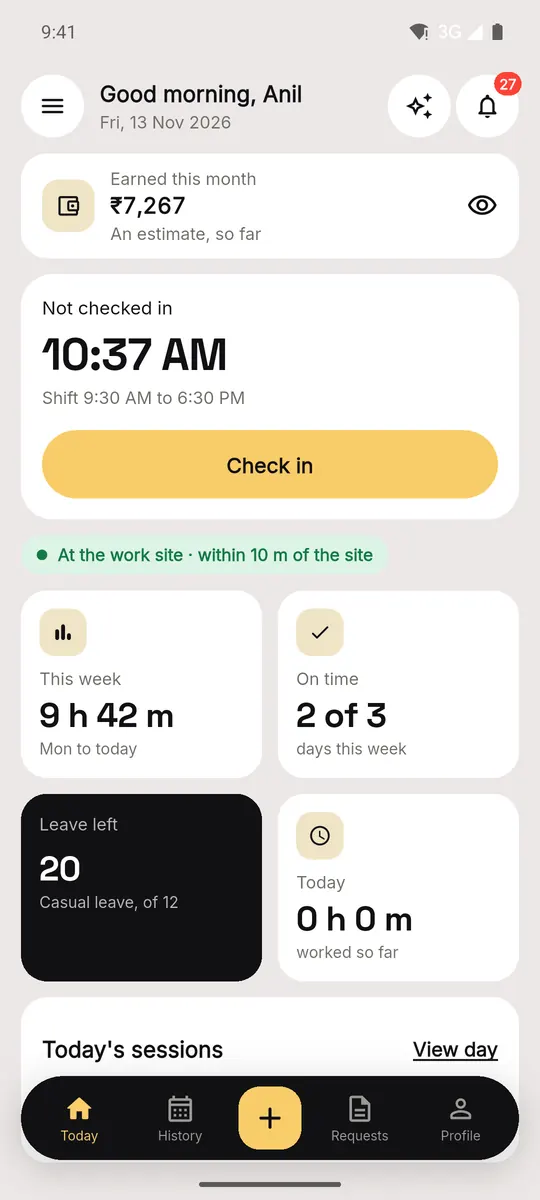
- Worker submits a request: The employee uses the Android app to select the type of leave (e.g., casual, sick, or earned leave) and the specific dates.
- Manager receives notification: The designated manager receives an instant notification in the app, showing the employee's name, the requested dates, and the current leave balance.
- Review and Approval: The manager views the request alongside the live attendance board to see who else is away, ensuring production coverage is not compromised.
- System updates automatically: Once approved, the leave is automatically marked in the attendance register, reflecting the status for that specific day.
- Payroll integration: When the payroll run is initiated, the system automatically pulls these approved leave records, ensuring that salary calculations are accurate without manual intervention.
- Audit trail: Every request, approval, and rejection is stored in an audit log, providing complete transparency for both the employee and the management.
Example scenario
This is an illustrative example, not a real customer. In a small electronics assembly unit, an operator needs to take two days off for a family function. On Monday, the operator uses the Velom app to request leave for the coming Thursday and Friday. The request instantly appears on the production supervisor's dashboard. The supervisor checks the attendance board and sees that the assembly line has sufficient staff for those days, so they click 'Approve'.
By Wednesday, the operator’s leave balance has been updated in the system. On Thursday and Friday, the operator does not check in, and the system correctly labels these days as 'Approved Leave' rather than 'Absent'. When the payroll cycle begins at the end of the month, the HR manager runs the payroll process. The system automatically recognises the two days of approved leave and processes the salary accordingly, without any need for the HR team to check old WhatsApp messages or paper slips. The entire process, from the initial request to the final payroll calculation, happens without a single manual entry or spreadsheet update.
What to check before you start
Before implementing a digital leave system, ensure your factory policies are clear and documented. Check the latest notification regarding the Ministry of Labour and Employment guidelines to ensure your leave types and allowances align with statutory requirements. Verify that your shift patterns and holiday lists are correctly configured in your management software. Ensure that your managers understand their role in reviewing requests promptly to avoid production bottlenecks. Finally, communicate the new process to your workers, explaining that digital requests are now the only valid way to apply for leave. This shift in culture is just as important as the technology itself.
For more on managing factory operations, you may want to look at payroll for small factories or explore how to manage loss of pay effectively.
By moving your leave management to a dedicated system, you gain control over your workforce. You stop chasing information and start managing your factory with accurate, real-time data.
Frequently asked questions
How does a structured leave approval workflow prevent payroll errors?
A structured workflow ensures that all approved leaves are automatically logged in the attendance register. Because these records are directly linked to the payroll system, the HR team does not need to manually calculate deductions or reconcile informal requests, which eliminates the risk of human error and pay discrepancies.
Can workers still ask for leave over the phone?
While workers may communicate verbally, the official record must be created in the app. Encouraging staff to use the app ensures that every request is tracked, approved, and accounted for, preventing the common issue of forgotten verbal agreements that lead to payroll disputes.
What happens if a manager is on leave when a request is submitted?
The system allows for defined roles and permissions. If a primary manager is away, other authorised personnel with the appropriate access rights can review and approve pending requests, ensuring that the workflow remains uninterrupted and production planning stays on track.
Does the system automatically update leave balances?
Yes. When a leave request is approved, the system automatically deducts the days from the employee's specific leave balance. This ensures that managers always have a clear view of how much leave an employee has remaining before they approve a new request.