Job work5 min read
Job Work Challan and ITC-04 Under GST: A Guide for Manufacturers
What a job work challan must show, how long goods may stay with a job worker, when ITC-04 is due, and how to keep track of stock sitting at vendors.
By Appikorn team ·
In this article
Short answer
Is GST payable when sending goods for job work?
No, if the principal is registered and the goods are sent under a challan and come back (or are supplied from the job worker's premises) within the time limits of Section 143.
Many small manufacturers send part of their work outside: PCB assembly to an SMT line, plating to a specialist, machining to a nearby workshop. Under GST this is job work, and it comes with a job work challan, time limits for the goods to come back, and the ITC-04 return. Get it right and you send materials without paying tax on them. Get it wrong and the goods can be treated as supplied, with tax and interest due. This guide walks through the rules and a simple way to track stock at vendors.
What counts as job work under GST
Job work means a person (the job worker) carries out a treatment or process on goods that belong to another registered person (the principal). Ownership does not change. Section 143 of the CGST Act lets the principal send inputs and capital goods to a job worker without paying tax, as long as the goods come back, or are supplied from the job worker's premises, within the time limits.
What the job work challan must show
Goods go to the job worker under a delivery challan, not a tax invoice. Rule 55 of the CGST Rules lists what it must contain:
- Date and a serial number (unique in the financial year, up to 16 characters).
- Name, address and GSTIN of the consignor (you).
- Name, address and GSTIN of the consignee (the job worker), if registered.
- HSN code and description of the goods.
- Quantity (provisional, where the exact quantity is not known).
- Taxable value.
- Tax rate and amount, where the movement is a supply (it is not, for job work, but the value is still shown).
- Place of supply, for inter-state movement.
- Signature of the supplier or an authorised person.
The challan is made in triplicate: the original for the consignee, the duplicate for the transporter and the triplicate for you. In practice, add your own internal references too: the production order or job, the lot numbers of what you sent, and the date by which you expect it back.
Time limits: one year and three years
| What you send | Must come back within |
|---|---|
| Inputs (components, raw material) | 1 year from the date they were sent |
| Capital goods (machines, equipment) | 3 years from the date they were sent |
| Moulds, dies, jigs, fixtures and tools | No time limit |
If inputs or capital goods do not come back in time, they are treated as supplied by you to the job worker on the day they were sent, and tax with interest becomes payable. The Commissioner can extend the period on sufficient cause, but do not plan on it. The practical lesson is to track every consignment against its return-by date and to look hard at anything older than ten months.
E-way bills for job work
For movement of goods to a job worker, the usual e-way bill rules apply, with one important difference: for inter-state movement of goods to a job worker, an e-way bill must be generated whatever the value of the consignment, either by the principal or by a registered job worker. Intra-state rules follow the general threshold and your state's notifications. Generate e-way bills on the e-way bill portal and note the number on the challan.
ITC-04: who files and when
ITC-04 is the return in which the principal reports goods sent to job workers, goods received back, and goods supplied directly from the job worker's premises. Since October 2021 the frequency depends on your aggregate annual turnover:
- Above ₹5 crore: half-yearly, for April to September (due 25 October) and October to March (due 25 April).
- Up to ₹5 crore: once a year, for the whole financial year (due 25 April).
Due dates are sometimes extended by notification, so check the GST portal and confirm with your accountant. ITC-04 needs challan-level detail, which is why a good record of every consignment matters more than the filing itself.
Tracking stock at the job worker
The materials at a job worker are still your stock. A simple system keeps, for each job worker and each part:
- Sent: the quantity on each challan, with the lot it came from.
- Used: worked out from the finished pieces that came back, multiplied by the bill of materials, not typed in by guesswork.
- Attrition: the normal process loss you agreed in advance (for example, a small allowance for machine pick-up loss in SMT).
- Returned: unused parts counted back into your store.
- Still there: what remains, with the days left before the return-by date.
When sent does not equal used, attrition, returned and still there added together, you have a loss that needs an explanation and an owner. Agree in writing whether losses beyond the allowance are charged to the job worker, and raise a debit note when they are.
A checklist for each consignment
- Challan made with all Rule 55 fields, in triplicate.
- E-way bill generated where required and its number noted.
- Return-by date written on your copy and entered in your tracker.
- Finished goods received against the challan, with good, rework and rejected quantities.
- Leftover parts counted back, or explicitly kept at the job worker for the next job.
- Tally done and losses explained before the job is closed.
How Velom helps
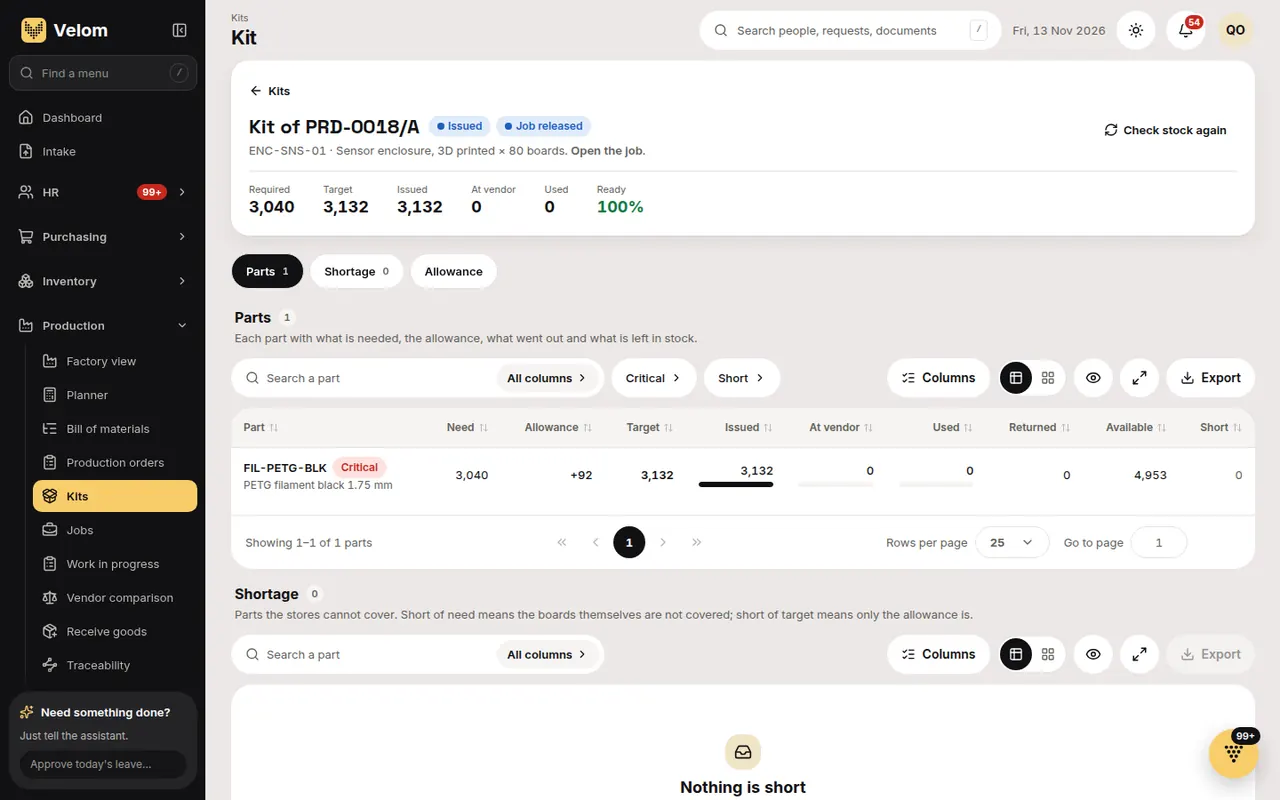
In Velom's production module, a vendor that does job work is an ordinary vendor with job work turned on. You send a job's kit to the vendor and Velom makes a numbered job work challan with the vendor's GSTIN, every line with lot, quantity and value, and a return-by date; you can add the e-way bill number and vehicle on the challan page. A Stock at vendors page shows, for each vendor, job and part, what was sent, used (counted from the boards that came back and the BOM), attrition, returned and still there, with days left. Reminders go to the store keeper before the return-by date and again as consignments approach the one-year mark. An ITC-04 data export gives the challans and returns for a period as a CSV for your accountant; it is working data, not the filing itself. See also Velom for electronics assembly.
Conclusion
Job work under GST is manageable when every consignment has a proper challan, a return-by date and a tally at the end. Keep the record at the level of challans and lots, and both ITC-04 and the conversation with your job worker become simple.
Frequently asked questions
Is GST payable when sending goods for job work?
No, if the principal is registered and the goods are sent under a challan and come back (or are supplied from the job worker's premises) within the time limits of Section 143.
How long can inputs stay with a job worker?
Inputs must return within one year and capital goods within three years of being sent. Moulds, dies, jigs, fixtures and tools have no time limit.
Who has to file ITC-04 and how often?
The principal files it. Taxpayers with aggregate turnover above ₹5 crore file half-yearly; those up to ₹5 crore file once a year. Check the GST portal for current due dates.
Is an e-way bill needed for job work?
For inter-state movement of goods to a job worker, an e-way bill is required whatever the value. Intra-state movement follows the general threshold and state rules.