Payroll5 min read
Payroll for Small Factories in India: PF, ESI, PT and Overtime
A month-by-month payroll routine for a small factory: from the attendance register to PF, ESI, professional tax and payslips workers can check.
By Appikorn team ·
In this article
Short answer
Is PF mandatory for a small factory?
EPF applies to establishments with 20 or more employees, and coverage is mandatory for employees whose PF wages are up to ₹15,000 a month. Smaller units can join voluntarily. Check the current rules on the EPFO website.
Payroll for a small factory in India is rarely hard because of the arithmetic. It is hard because the inputs arrive late and disagree: the attendance register says one thing, the supervisor remembers another, overtime was promised on the phone, and PF and ESI have to be paid by a fixed date whatever happens. This guide sets out a monthly payroll routine that a small HR team or an owner can follow, with the statutory deductions explained in plain terms.
Start with the salary structure
Every worker's monthly pay should be written as components, not as one number. A typical structure has Basic (and Dearness Allowance where you pay it), House Rent Allowance, and a Special or Other allowance. The split matters because PF is calculated on Basic plus DA, and because the labour codes that the central government brought into force in November 2025 define "wages" so that allowances above half of total pay are added back when calculating some benefits. Ask your accountant to check that your structure fits the current wage definition before the next revision.
Record for each worker: date of joining, PAN, UAN for PF, ESI number where it applies, bank account, and whether PF, ESI and professional tax apply to them. A change in salary should be a new structure from a date, never an overwrite, so arrears can be worked out later.
Attendance-linked pay: days payable and loss of pay
For daily-rated and monthly-rated workers alike, the first number is days payable. Decide your basis once and keep it:
- Calendar-day basis: monthly salary divided by the days in the month.
- Fixed-day basis: monthly salary divided by a fixed number such as 26 or 30.
Days payable are days present, paid holidays and weekly offs, and approved paid leave. Loss of pay (LOP) days are absences without approved leave. The most common payroll dispute in factories is an absence that was really a forgotten check-out, so settle every open punch and pending leave request before you calculate.
Overtime
Overtime in a factory is not a matter of policy alone. Under the Factories Act, and now the labour codes, a worker who works beyond the daily or weekly limit is entitled to overtime at twice the ordinary rate of wages. Check your state's rules for the exact limits and for any approvals needed for longer hours. Practically:
- Overtime hours should come from the attendance record, not from a separate note.
- Write down when overtime starts (after the shift's hours or after a daily limit) and apply it the same way to everyone.
- Keep an overtime register; inspectors ask for it.
PF, ESI and professional tax in plain terms
| Deduction | Who it covers | Rate (check current notification) | Paid by |
|---|---|---|---|
| Provident Fund (EPF) | Establishments with 20 or more employees; mandatory for employees earning up to ₹15,000 a month in PF wages | 12% of Basic plus DA from the employee, 12% from the employer (of which 8.33% up to the ₹15,000 ceiling goes to the pension scheme) | 15th of the following month, through the ECR on the EPFO portal |
| ESI | Covered establishments (generally 10 or more employees) for employees earning up to ₹21,000 a month | 0.75% from the employee, 3.25% from the employer | 15th of the following month, on the ESIC portal |
| Professional tax | Set by each state; some states do not levy it | Slabs by salary, up to ₹2,500 a year | As the state's rules say (monthly, half-yearly or yearly) |
Rates, ceilings and due dates are revised from time to time, so confirm them on the EPFO and ESIC websites and with your accountant. Income tax (TDS on salary) applies to employees whose taxable income crosses the limit for the regime they chose; collect each employee's choice of regime and their investment declarations early in the financial year.
A monthly payroll checklist
- Close attendance on the first working day after month end: all punches reviewed, missing check-outs corrected, flagged punches explained.
- Close leave: approve or reject every pending request for the month.
- Collect changes: new joiners, leavers, salary revisions, advances to recover, bonuses or incentives. Each adjustment needs an amount, a reason and an approver who is not the person entering it.
- Calculate and read the exceptions first: people with no bank account, no salary structure or unresolved attendance should be held, not paid a guessed amount.
- Review: compare total net pay with last month and explain any large change.
- Approve and lock the month so the figures cannot drift after payment.
- Pay salaries and record the bank reference.
- Pay PF and ESI and file returns before the 15th; pay professional tax as your state requires.
- Publish payslips to every worker.
Payslips workers can check
A payslip should let a worker check their own pay without asking HR: days in the month, days payable, LOP days, overtime hours, each earning, each deduction, net pay, and their UAN and ESI numbers. When workers can see what they have earned so far during the month, fewer questions arrive on pay day. Keep payslips available for download for at least the period your records must be retained.
Common mistakes to avoid
- Calculating pay before attendance is closed, then correcting it with manual arrears.
- Applying PF on gross pay for some workers and on Basic for others without a written decision.
- Forgetting that ESI coverage is decided by wages in the contribution period, not at joining only.
- Letting the person who prepares payroll also approve it.
- Paying overtime at the wrong multiple because the software default was never checked.
How Velom helps
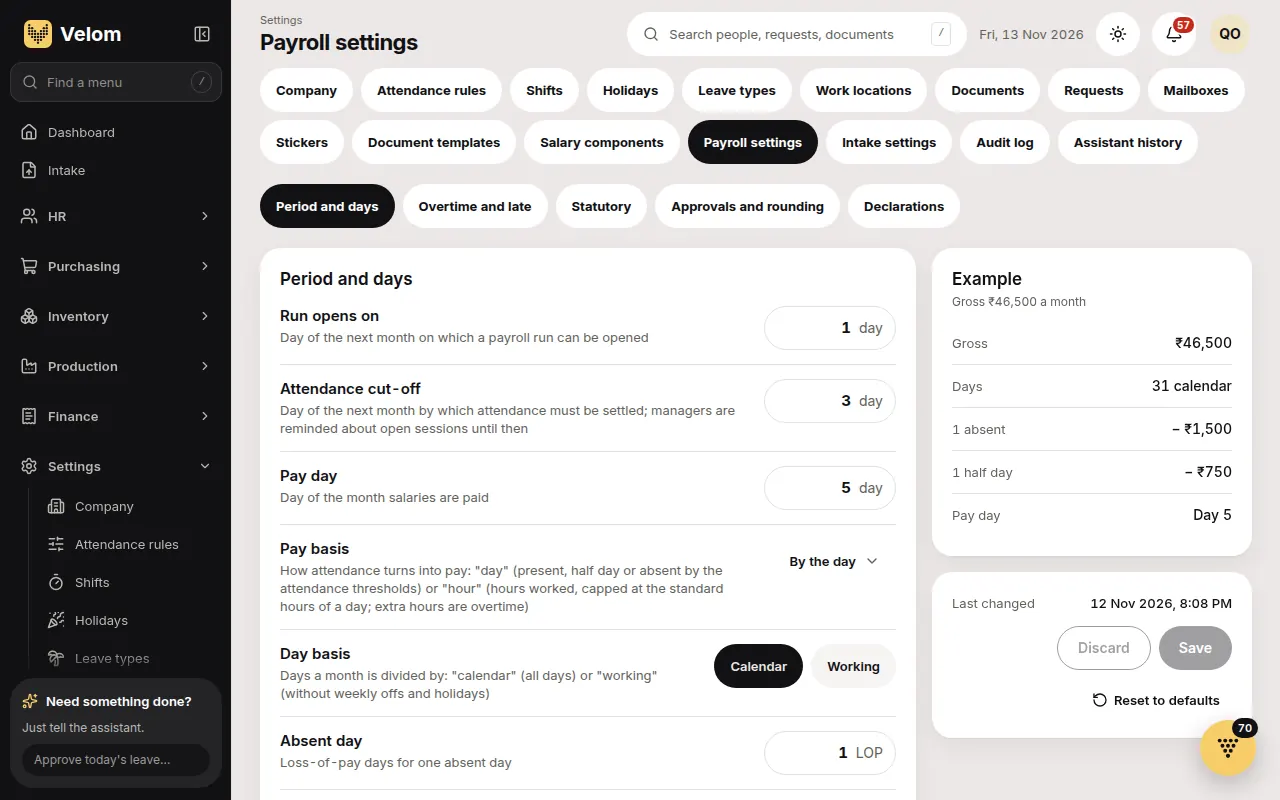
Velom's payroll takes days and hours only from the attendance register, the same numbers employees see on their phones. A monthly run moves from Draft to Calculated, Under review, Approved and Locked, and anyone whose attendance or salary is not settled is blocked with the reason and a link to fix it, rather than paid a guessed amount. The statutory settings (PF, ESI, professional tax, overtime multiple, day basis) are in Payroll settings for the Owner to set with the accountant. Adjustments need a second person to approve, locking publishes payslips as PDFs, and employees can see their earnings for the month so far. Because attendance comes from face check-in with location flags, most disputes are settled before payroll starts.
Conclusion
A reliable payroll in a small factory comes from a fixed routine: close attendance first, settle exceptions before calculating, keep the statutory settings checked by your accountant, and lock the month once it is approved. The software does the arithmetic; the routine makes the numbers trusted.
Frequently asked questions
Is PF mandatory for a small factory?
EPF applies to establishments with 20 or more employees, and coverage is mandatory for employees whose PF wages are up to ₹15,000 a month. Smaller units can join voluntarily. Check the current rules on the EPFO website.
What is the ESI contribution rate?
Currently 0.75% of wages from the employee and 3.25% from the employer, for employees earning up to ₹21,000 a month in covered establishments. Confirm the current rates on the ESIC website.
How is overtime paid in a factory in India?
Work beyond the daily or weekly limit is paid at twice the ordinary rate of wages under the Factories Act and the labour codes. Check your state rules for limits and approvals.
Does every state charge professional tax?
No. Professional tax is a state levy and some states do not charge it. Where it applies, the maximum is ₹2,500 a year and the slabs and due dates follow the state rules.