Production6 min read
Production Order Management: Kits, Allowances and Avoiding Shortages
Effective production planning prevents material shortages and inventory leakage. Learn how to manage production orders, kits, and part allowances systematically.
By Appikorn team ·
In this article
Short answer
How does a production order management system prevent material shortages?
It prevents shortages by calculating the exact parts required for a production order based on your Bill of Materials. By comparing these requirements against your real-time inventory and open purchase orders, it flags missing items before production starts, allowing the purchase team to procure them in time.
The problem: a realistic day in an Indian SME factory
In a typical Indian SME factory, the morning begins with a flurry of activity. The production manager arrives to find that the team is ready to start a new batch of 100 units. However, the store keeper reports that while the main components are available, several small fasteners or electronic resistors are missing. This is a common scenario where the actual stock on the floor does not match the digital ledger. Because there is no formal system to link specific parts to a specific job, these small items are often treated as common pool inventory.
As the day progresses, the production team discovers that the missing parts are critical for the assembly. The production order is stalled, and the floor supervisor begins to scramble. Workers are reassigned to other tasks, and the momentum of the shift is lost. Worse, when the missing parts are eventually found or replaced, they are often scattered across different workstations or kept in open trays where they are easily misplaced or pilfered. Without a structured way to issue kits for each specific job, the factory suffers from constant disruptions and an inability to account for where materials have been consumed.
What it costs: time, rework, money and risk
The cost of poor production planning extends far beyond the price of the missing components. When a production order is delayed, the factory incurs a significant opportunity cost. Labour costs continue to accrue even when the assembly line is idle. Furthermore, the constant starting and stopping of production runs lead to fatigue and an increase in assembly errors. Rework becomes inevitable when workers are forced to rush to meet deadlines after a delay, which often results in poor quality output that may be rejected by the customer.
From a financial perspective, the lack of strict material control leads to inventory shrinkage. When parts are not tied to a specific production run, it becomes impossible to track whether a variance is due to wastage, theft, or simple miscounting. This creates a cycle of over-purchasing to compensate for perceived shortages, tying up capital in excess inventory that could have been used for more productive purposes. The operational risk is also high; failing to meet delivery schedules can damage relationships with key clients and lead to loss of future business.
How the team did it before: paper, spreadsheets, WhatsApp
Before adopting a digital system, most teams rely on a combination of manual processes. The production manager might write a list of required parts on a piece of paper or a small whiteboard. This list is then handed to the store keeper, who checks the physical shelves and tries to assemble the items. If a part is missing, the store keeper might send a message on WhatsApp to the purchase manager, who then has to check their own spreadsheet to see if an order has been placed or if a vendor has been contacted.
This reliance on fragmented tools creates a massive communication gap. Spreadsheets are rarely updated in real-time, leading to a situation where the store keeper thinks a part is available while the purchase manager knows it is delayed. There is no central record of what was issued to which job. If a worker takes extra parts for a job, there is no formal process to return them or account for the surplus. This leads to a "black box" of inventory where items enter the factory but their final destination is never recorded, making it impossible to perform an accurate audit or reconcile stock levels at month-end.
How Velom solves it, step by step
Velom brings structure to the factory floor by digitising the entire production lifecycle. By using the production features, you can ensure that every part is accounted for and every job is kitted correctly before work begins. This approach eliminates the guesswork that leads to production delays and inventory loss.
- Define the Bill of Materials: Create a multi-level BOM that lists every part required for a single unit of your product.
- Plan the Production Order: Use the planner to multiply the BOM by the target quantity. The system automatically subtracts current stock and open orders to highlight exactly what is short.
- Create Production Runs: Split your total order into manageable runs (jobs). Each run is treated as a distinct entity with its own requirements.
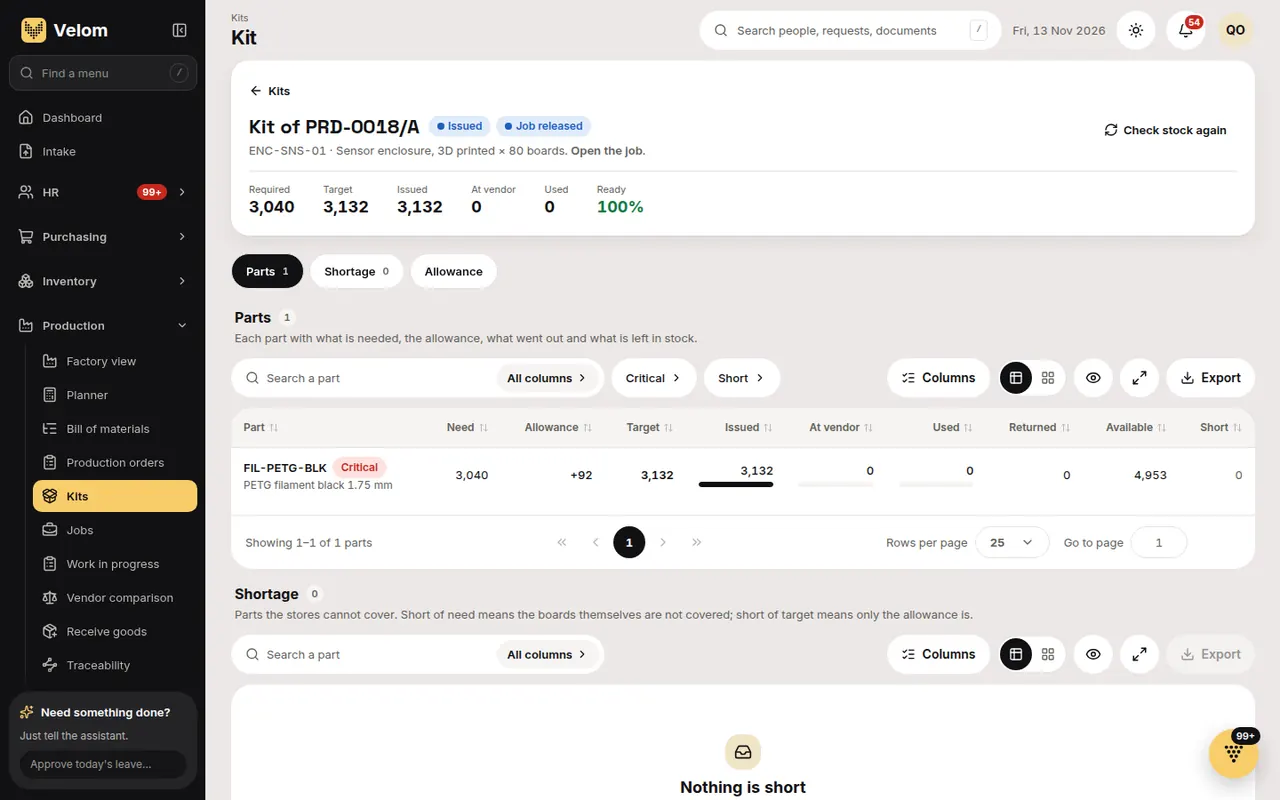
- Issue Kits: Prepare a kit for each run. This includes the required parts plus a defined allowance for attrition, ensuring workers have exactly what they need without excess.
- Track Movements: Every part issued to a run is recorded. The system tracks items as issued, at the vendor, used, or returned, providing a clear view of variance.
- Review and Approve: Managers review the readiness of each run. Nothing is finalised or deducted from inventory until the kit is approved.
- Analyse Variances: After the run, compare the parts used against the BOM to identify wastage or process inefficiencies.
Example scenario
This is an illustrative example, not a real customer. Imagine a factory that produces 100 power supply units. One week before the production order is due, the planner runs the calculation in Velom. The system identifies that while the main transformers are in stock, the specific capacitors are short by 50 pieces. The purchase manager is alerted instantly and places an order with a preferred vendor. By the time the production week begins, the parts have arrived and been inspected.
The production manager creates two runs of 50 units each. For each run, the store keeper issues a kit that includes the exact number of capacitors plus a small, pre-set allowance for potential damage during assembly. The workers sign for their kits. During the first run, the team uses 48 capacitors and returns the remaining 2, which are added back to the store inventory. At the end of the week, the second run is completed with minimal waste. Because every movement was logged, the inventory balance is accurate, and the factory has successfully avoided the usual "missing parts" panic that previously delayed their output.
What to check before you start
Before implementing a structured production system, ensure your foundation is solid. Start by verifying your inventory data; if your stock records are inaccurate, the system cannot predict shortages correctly. Ensure all your inventory items have unique SKUs and that your BOMs are updated to reflect the current design of your products. It is also helpful to establish clear roles for who is authorised to approve kits and who can adjust production quantities. Finally, check the latest notification regarding GST regulations if you are sending parts to job workers, as compliance with ITC-04 and movement tracking is essential for tax reporting. By standardising your data and processes, you ensure that the system provides reliable insights rather than just more paperwork.
Frequently asked questions
How does a production order management system prevent material shortages?
It prevents shortages by calculating the exact parts required for a production order based on your Bill of Materials. By comparing these requirements against your real-time inventory and open purchase orders, it flags missing items before production starts, allowing the purchase team to procure them in time.
What is an attrition allowance in a production kit?
An attrition allowance is a small, pre-defined quantity of extra parts included in a production kit to account for potential damage, loss, or defects during the assembly process. This prevents workers from having to stop production to request replacements for minor issues.
Can I split a large production order into smaller jobs?
Yes, you can split a large production order into multiple runs or jobs. This allows you to manage the factory floor more effectively, track the progress of specific batches, and issue kits based on the requirements of each individual run rather than the entire order at once.
How do I account for parts that are not used in a production run?
In a formal system, any parts not used in a production run are recorded as returned to the store. This movement updates the inventory ledger automatically, ensuring that your stock balances remain accurate and that unused items are not lost or treated as consumed.