GST billing5 min read
GST Tax Invoice for Small Manufacturers: Fields, HSN and E-way Bills
A plain checklist for GST invoices in a small manufacturing unit: mandatory fields, HSN digits, tax type, credit notes, e-way bills and when e-invoicing applies.
By Appikorn team ·
In this article
Short answer
How many HSN digits must a small manufacturer show on invoices?
With aggregate turnover up to ₹5 crore in the previous year, 4 digits on B2B invoices; above ₹5 crore, 6 digits on all invoices.
A small manufacturer issues tax invoices every day, and each one decides whether the customer can claim input tax credit and whether your GST returns reconcile. Most errors are simple: a missing HSN code, the wrong tax type for an inter-state sale, a number series that restarted in the middle of the year. This guide is a practical checklist for the GST tax invoice, with the related pieces you will meet alongside it: credit and debit notes, e-way bills and e-invoicing.
What a GST tax invoice must contain
Rule 46 of the CGST Rules lists the contents of a tax invoice. For a typical B2B sale by a manufacturer, check that every invoice shows:
- Your name, address and GSTIN.
- A consecutive serial number, unique for the financial year, of up to 16 characters (letters, numbers, hyphen and slash).
- Date of issue.
- The customer's name, address and GSTIN.
- HSN code of the goods.
- Description, quantity and unit.
- Total value and taxable value after any discount.
- Tax rate and amount for each tax: CGST and SGST (or UTGST), or IGST, and cess where it applies.
- Place of supply, with the state name, for inter-state supplies.
- Delivery address if it differs from the place of supply.
- Whether tax is payable on reverse charge.
- Signature or digital signature of you or an authorised person.
For a sale to an unregistered customer, the rules relax some fields for low-value invoices, but most manufacturers selling B2B should simply fill every field every time.
HSN digits by turnover
The number of HSN digits you must show depends on your aggregate turnover in the previous financial year:
| Aggregate turnover (previous year) | HSN digits on invoices |
|---|---|
| Up to ₹5 crore | 4 digits on B2B invoices |
| Above ₹5 crore | 6 digits on all invoices |
Keep the HSN code on the item master so it flows into every invoice, and so your HSN summary in GSTR-1 adds up without manual work.
CGST and SGST, or IGST?
The tax type follows the place of supply, which for goods is usually where the movement ends (the customer's delivery location):
- Your state and the place of supply are the same: charge CGST and SGST, each at half the rate.
- They are different: charge IGST at the full rate.
The most common slip is billing a customer whose billing address is in your state but whose goods are shipped to another state. Decide the place of supply from the shipment and check it on every inter-state dispatch.
Invoice numbering
Use one or more series, each consecutive with no gaps, and restart only at the start of a financial year if you choose to. A common pattern is a prefix, the year and a running number, for example INV/26-27/0001. Keep it within 16 characters. Never reuse a number, and do not delete an issued invoice: correct it with a credit or debit note.
Credit and debit notes
When an invoice turns out to be wrong after it is issued, the correction is a note, not an edit:
- Credit note: the taxable value or tax charged was too high, or goods were returned or rejected. It reduces your tax liability.
- Debit note: the taxable value or tax charged was too low. It increases your liability.
Each note should refer to the original invoice. A credit note must be declared in a return no later than 30 November following the end of the financial year of the original supply, or the date of filing the annual return, whichever is earlier. Check the current rule with your accountant, because the date has been changed before.
E-way bill basics
An e-way bill is generally required when goods worth more than ₹50,000 in one consignment are moved by a motor vehicle; some states set a different limit for movement within the state. It has two parts:
- Part A: the details of the goods and the document, including the recipient's GSTIN, the delivery PIN code, the invoice or challan number and date, the value, the HSN code and the reason for transport.
- Part B: the transport details, mainly the vehicle number (or the transporter's document).
The validity depends on the distance. Generate it on the e-way bill portal before the goods leave and print the number on the invoice or challan. Goods sent to a job worker across state lines need an e-way bill whatever their value; the job work challan guide covers that case in detail.
When e-invoicing applies
E-invoicing (reporting B2B invoices to the Invoice Registration Portal to get an IRN and QR code) is mandatory for businesses whose aggregate turnover exceeded ₹5 crore in any financial year from 2017-18 onwards. If you are near that threshold, plan for it before you cross it. Larger taxpayers also face a time limit for reporting invoices to the portal; check the current notifications on the GST portal.
A daily invoicing checklist
- Invoice made from what was actually dispatched, not from the order.
- Customer GSTIN and PAN checked; the PAN is part of the GSTIN.
- Place of supply and tax type checked against the delivery address.
- HSN on every line, with the right number of digits.
- Rates match the order; quantities do not exceed what is open.
- E-way bill generated where needed and its number on the invoice.
- Number taken from the series only when the invoice is issued.
How Velom helps
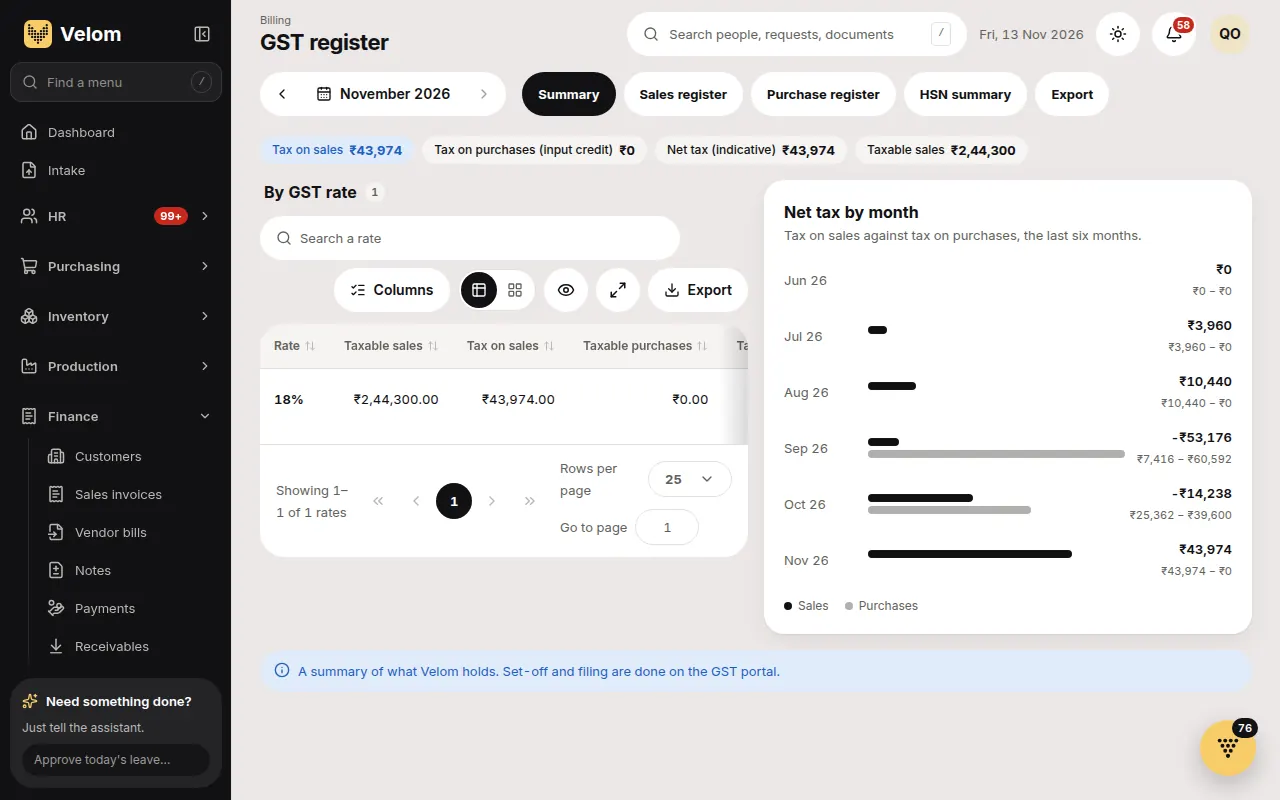
Velom's billing turns a dispatch or a customer order into a sales invoice in four steps. It warns when a quantity is above what is open, a rate differs from the order or an HSN code is missing, and it applies CGST and SGST or IGST from the customer's state. Drafts carry a temporary number; the real number is given only on issue, from a pattern you set (up to 16 characters, no gaps). Issued invoices are never deleted; they are corrected with credit or debit notes that point to the original. The GST register shows sales, purchases and the HSN summary by month, with CSV exports in the GSTR-1 layout. E-way bill and e-invoice numbers are typed in by hand; Velom does not connect to the government portals, and filing stays on the GST portal.
Conclusion
A clean GST invoice is mostly discipline: complete fields, the right HSN digits, the right tax type and a number series without gaps. Build those into your daily routine, correct mistakes with notes rather than edits, and your returns will reconcile with far less effort at month end.
Frequently asked questions
How many HSN digits must a small manufacturer show on invoices?
With aggregate turnover up to ₹5 crore in the previous year, 4 digits on B2B invoices; above ₹5 crore, 6 digits on all invoices.
When do I charge IGST instead of CGST and SGST?
When the place of supply is in a different state from yours. For goods this is usually where the delivery ends, not the billing address.
Can I edit or cancel an issued GST invoice?
Correct an issued invoice with a credit or debit note that refers to it. Do not change or reuse the invoice number.
When is an e-way bill required?
Generally when goods worth more than ₹50,000 in one consignment move by motor vehicle, with state-specific limits for movement within some states. Inter-state movement to a job worker needs one whatever the value.
Is e-invoicing mandatory for small manufacturers?
Only once aggregate turnover has exceeded ₹5 crore in any financial year from 2017-18. Check the GST portal for current notifications.